
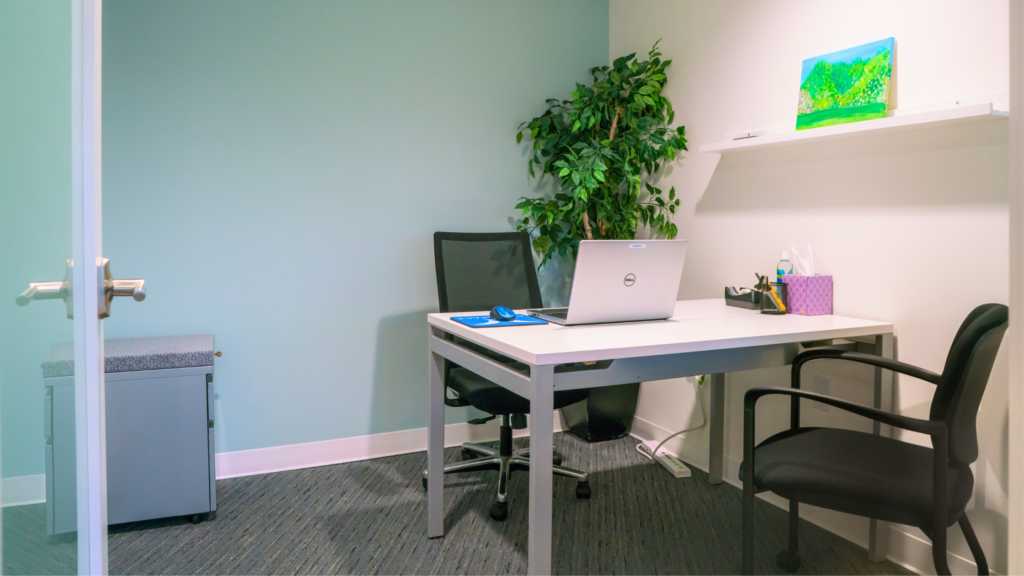
The Psychology Behind Why Environment Impacts Productivity
Most people assume productivity is about willpower, discipline, or better planning tools. But research in cognitive psychology and behavioral science consistently shows something different:
👉 Your environment is one of the strongest predictors of your ability to focus and perform.
From lighting and noise to social presence and spatial design, your surroundings continuously influence how your brain allocates attention, energy, and motivation.
The Role of “Body Doubling” in Focus
One of the most interesting productivity techniques backed by psychology is body doubling.
Body doubling means working alongside another person (physically or virtually) while doing separate tasks. There is no need to interact—the simple presence of another focused person helps regulate attention.
This technique is widely used in ADHD coaching and is now being adopted by remote workers, freelancers, and hybrid teams.
Why it works:
- It increases accountability (you are less likely to drift off-task)
- It reduces task avoidance
- It creates gentle social pressure to stay focused
- It mimics the structure of an office environment
Research into co-presence and workplace behavior supports this effect. Studies on social facilitation show that people tend to perform better on well-learned or structured tasks when others are present, even if they are not interacting directly.
Source: https://www.apa.org/pubs/journals/reviews/social-facilitation
This is also closely linked to attention anchoring, where another focused individual acts as a behavioral cue that reinforces your own concentration.
In structured environments like CapeSpace, this principle happens naturally—people working independently in a shared professional space often experience the same “body doubling” effect without planning it.
Environmental Design and Cognitive Load
Another key concept is cognitive load theory.
Your brain has a limited amount of mental bandwidth. Every distraction in your environment—noise, clutter, interruptions—adds cognitive load that reduces your ability to think deeply and solve problems.
Research shows that workspace design significantly affects performance and well-being. A study published on coworking environments found that both physical design and social context influence productivity outcomes.
Source: https://www.sciencedirect.com/science/article/pii/S1472596718000273
Key findings include:
- well-designed environments improve productivity and motivation
- flexible workspaces enhance performance
- excessive noise and poor layout reduce focus
This is why minimal, structured environments consistently outperform chaotic or unpredictable ones when deep work is required.
Why Social Environments Matter So Much
Humans are fundamentally social creatures—even when working alone.
Work environments influence:
- motivation levels
- emotional regulation
- sense of belonging
- persistence on difficult tasks
Studies show that positive social interaction in work environments correlates with higher engagement and productivity.
Source: https://journals.sagepub.com/doi/10.3233/WOR-220353
However, balance is critical:
- too much isolation → low motivation and procrastination
- too much interaction → distraction and fragmented focus
This is why hybrid environments that combine quiet focus zones with optional social connection tend to be most effective.
Coworking spaces like CapeSpace are built around this balance—offering both private offices and shared environments depending on how people prefer to work.
Flow State: The Ideal Productivity Zone
The “flow state” is a psychological condition where a person becomes fully immersed in a task, often losing track of time.
To reach flow, research suggests you need:
- low distractions
- clear structure
- immediate feedback loops
- balanced challenge and skill level
- stable environmental conditions
According to flow theory research, environmental stability plays a key role in enabling sustained attention and deep cognitive engagement.
Source: https://positivepsychology.com/mihaly-csikszentmihalyi-father-of-flow/
Even subtle changes—like lighting, background noise, or proximity to others—can determine whether you enter flow or remain in fragmented attention states.
The Modern Solution: Structured Work Environments
As remote and hybrid work becomes the norm, more professionals are actively seeking environments that support focus without isolation.
This is where coworking spaces come in.
A well-designed coworking environment provides:
- separation between home and work life
- reduced distractions
- professional atmosphere
- built-in accountability
- opportunities for social interaction without obligation
Spaces like CapeSpace are designed specifically to support these psychological needs. With private offices, shared work areas, and meeting rooms, they remove the friction of working from home while still giving flexibility and control.
Instead of relying purely on discipline, the environment itself encourages better focus habits.
Productivity is not just a personal trait—it is an environmental outcome.
Your brain is constantly responding to cues from your surroundings, whether that’s noise, structure, social presence, or spatial design. Techniques like body doubling, cognitive load management, and structured work environments don’t just “improve focus”—they reduce the mental friction that prevents it in the first place.
If productivity feels inconsistent, the solution may not be more effort.
It may be a better environment.